Contextro turns workflows into structured context for AI implementation.
A framework for translating messy business workflows into a structured specification that AI systems can actually work with.
See how it works →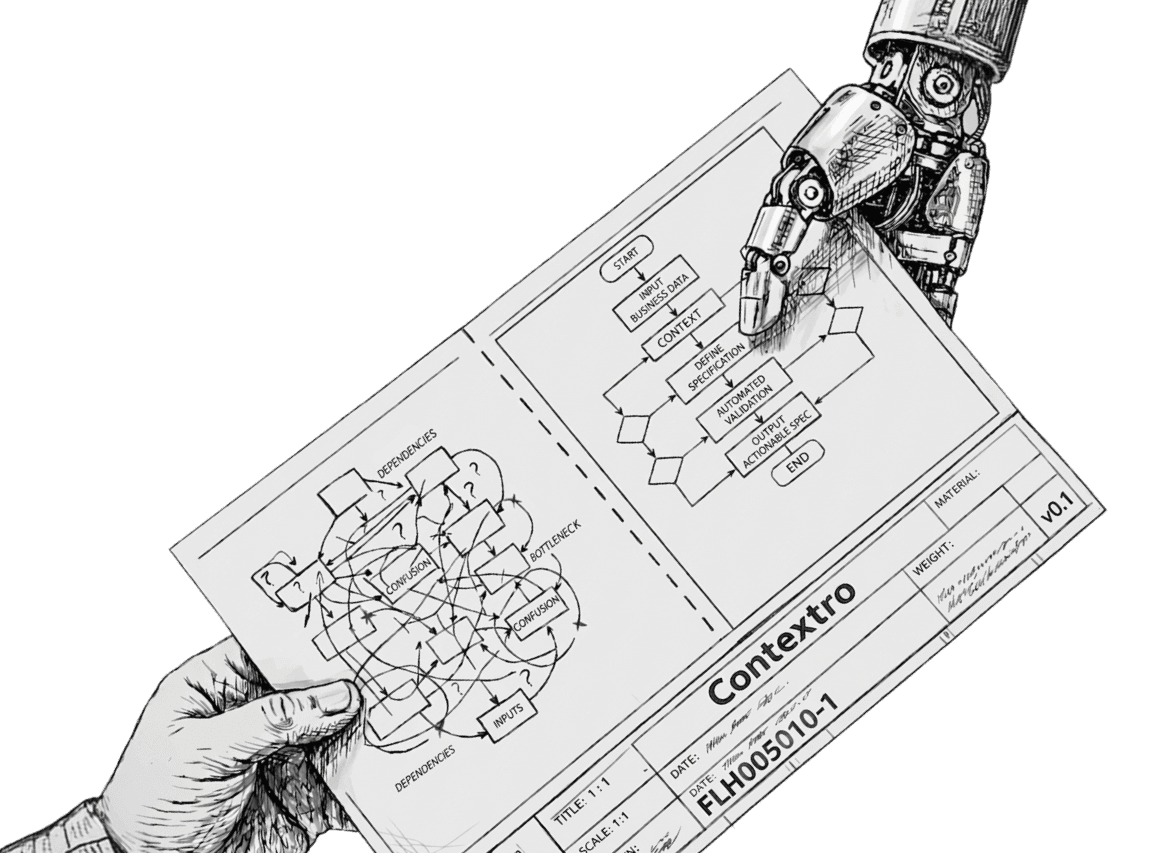
Contextro turns workflows into structured context for AI implementation.
A framework for translating messy business workflows into a structured specification that AI systems can actually work with.
See how it works →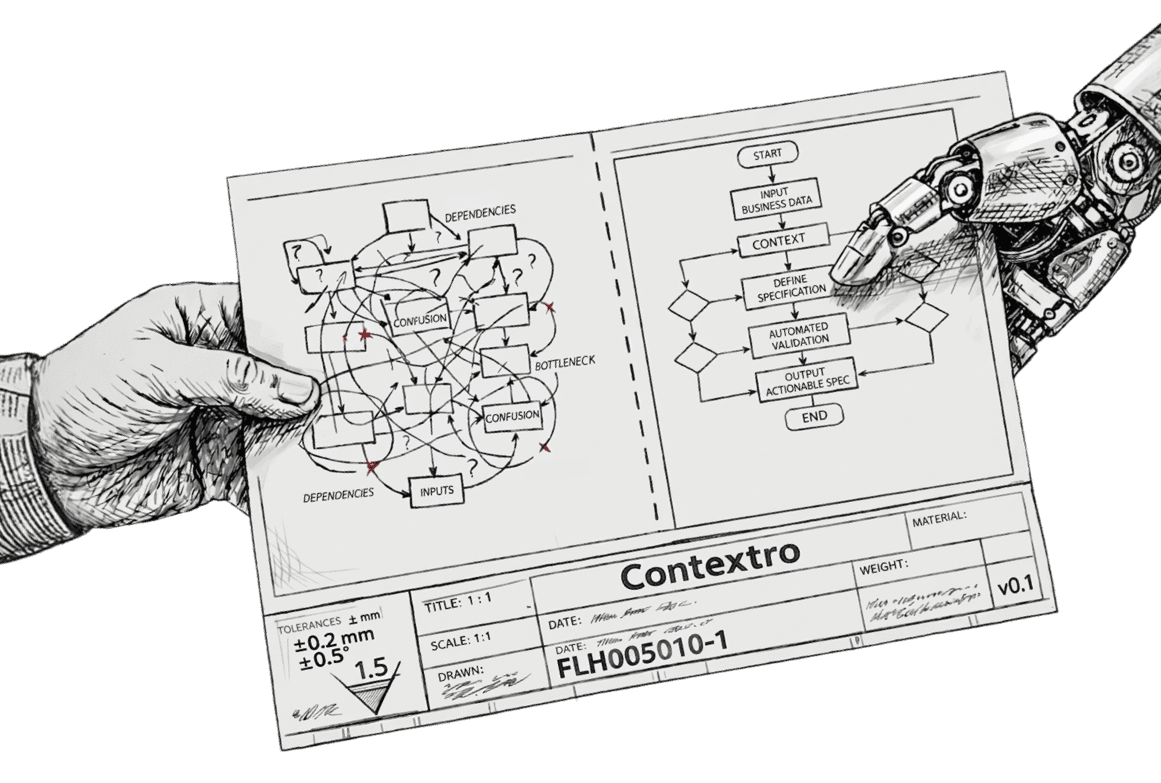
Most AI implementation starts in the wrong place.
Organisations begin with tools, models, prompts, or agent ideas. They move fast, experiment broadly, and get limited results. The usual explanation is that the AI is not good enough, or the use case is not quite right.
The actual issue is more fundamental. Workflows inside real organisations are undocumented in the way they actually run. They are spread across people, tools, files, and informal decisions. They depend on rules no one has written down and judgment no one has explained. They have no clear definition of what a good output looks like.
AI systems cannot operate effectively in that kind of ambiguity. They need defined inputs, explicit rules, known constraints, clear outputs. Without that structure, even well-chosen AI will underperform.
The gap is not in the AI. It is in the workflow.
sarah usually handles the intake emails
if it's urgent someone pings the channel
docs go in the shared drive somewhere
we check with legal if it looks risky
output depends on who's doing it
turnaround is "a few days usually"
Contextro is a context-driven workflow specification framework.
It is designed to take workflows as they actually exist (informal, fragmented, tacit) and translate them into structured context that AI systems can work within.
The key concept is context. In Contextro, context does not mean background information. It means the full working structure an AI system needs to operate reliably inside a workflow: its goals, inputs, rules, decision logic, system access, memory requirements, human checkpoints, and success criteria.
A process map shows what happens. A Contextro specification defines what an AI system would need in order to participate in, support, or run that workflow safely and effectively.
That distinction — between process description and context specification — is what makes Contextro different.
“A process map shows what happens. A Contextro specification defines what an AI system needs in order to operate.”
The Contextro process operates across three layers.
Most AI implementation efforts fail at one of three points: starting with the wrong workflow, producing a specification that is never built, or building something that degrades without oversight. The three-layer structure addresses each directly. The pre-process ensures effort goes into the right workflow before analysis begins. The four core phases move sequentially — each only possible because the previous one is complete — from raw workflow to an implementation-ready specification. The post-process closes the gap between that specification and a working, maintained system.
Map the organisation's work landscape and identify which workflows to examine. The Knowledge Work Map reveals where AI implementation will create the most value, before any deep analysis begins. For organisations without a defined starting point.
Document how the workflow actually runs today — not how it is supposed to run. Surface the real steps, the workarounds, the tacit rules, and the informal decisions that never appear in official documentation.
Break the workflow into its constituent tasks and map each one against the full thirteen context dimensions. This is where the workflow moves from narrative description to structured, dimension-by-dimension analysis.
Evaluate each part of the workflow for AI suitability and determine the right intervention type: whether to augment, transform, productise, or leave the task fully human-led.
Produce the Contextro Spec, the structured context specification for the target-state workflow. Define the target state, human checkpoints, role transitions, and implementation requirements. This is the primary deliverable of the core process.
Translate the Contextro Spec into a Build Brief with spec-to-build traceability, and validate that what is built matches what the spec defined before it goes live.
Define how the implemented workflow will be monitored, evaluated, and improved over time. Implementation without governance degrades.
Contextro produces structured, usable artifacts — not reports.
The outputs of Contextro are designed to be used, not filed. Each artifact has a specific audience and purpose.
These artifacts are designed to be used by humans to redesign work, by builders to implement AI systems, and by AI models themselves as structured operating context.
A framework built on one belief.
AI implementation succeeds when workflows are translated into the right context structure. Not when the right tool is chosen. Not when the right model is deployed. When the workflow itself has been properly understood and specified.
Contextro was developed by Exvolve to make that work more structured, more repeatable, and more defensible. It is a proprietary method and will continue to evolve.
Contextro is where AI starts working.
To learn more about the framework, send us an email.
Contextro v0.4 — developed by Exvolve